
Digest #1
Weekly Roundup, Commentary, Spotlight, Updates, Readings

I’m going to do regular Digests going forward, a roundup of stuff online with commentary and reading recommendations. After this one, they’ll be paywalled.
Roundup
Michael Lynch’s response this week at American Reformer to Kevin DeYoung’s “6 Questions for Christian Nationalists” is pitch perfect. Lots of good feedback for it online. Go read it! Lynch’s answer to Question #4 is the best short case for the independent theological judgment of the magistrate in one paragraph. This is a distinctly Protestant conviction. If the magistrate is incompetent to discern what true religion and piety are then he’s incompetent to perform any moral task or consider whether any profession is performing malpractice.
Here’s Francis Turretin with backup (Institutes, III.XXXIV.XIX):
“[T]he Christian magistrate has the right of knowing and judging concerning matters of faith, at least with a discretive and approving judgment, whether he ought to confirm by his authority the judgments of the church and commit them to execution. But according to the Romanists, the church alone judges by a supreme, definitive and infallible judgment, which the magistrate (equally with the private person) is bound simply and with implicit faith to embrace and to put into execution without any preceding judgment of discretion upon the judgment of the church.”
Also, watch Stephen Wolfe’s point-by-point breakdown (“Dismantling DeYoung”) of DeYoung’s article. It’s long but totally worth it! An important point Stephen makes about historical principles and prudence:
“We’re not appealing and saying let’s go back to Geneva. When I cite people of the 16th and 17th century it’s mainly to develop the principles because they did politics better, they understood political theory better than practically anyone nowadays. And so, I’m going to go back to them, look at their theology, I’m going to build a Christian political thought from it. But that doesn’t mean when you apply those principles it means going back to Geneva. You can take the principles from Geneva and say that in the American context things have to be a bit different. That’s how politics works.”
Though I let my print subscription drop a long time ago, History Today is one of the few pop level history publications I still read with some frequency. How can you not when their promotions are like this?

(Look at their paywall message too.) Though you should realize, as the top notch poaster, Presbyterian Inn, pointed out the other day, that what was being canceled back then was not exactly the Christmas you think of now.
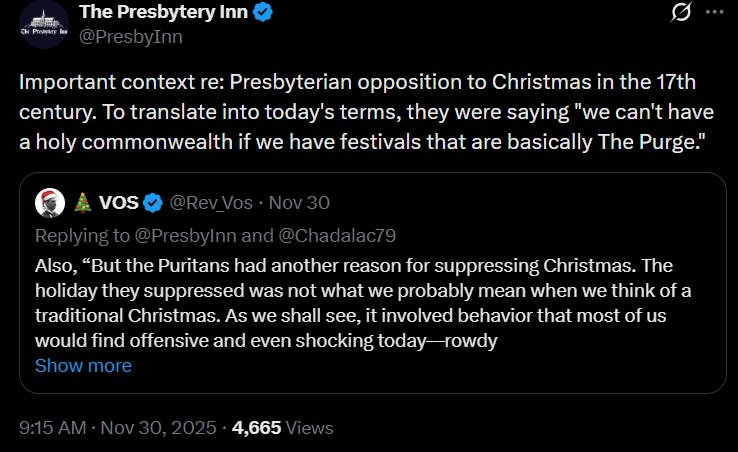
Underlying post from another good poaster:

A little more Cromwell(s) in a moment. Speaking of “dour” Puritans, I put this myth to bed in my essay for Religion & Liberty back in March. Working on another essay currently for a different publication, I was reminded that one of the biggest complaints of New Englanders in the 1680s when Edmund Andros took over and consolidated half the eastern seaboard was an increasing on alcohol duties. That’s your Puritan killjoys for you.
The theme of December’s History Today issue is Henry VIII’s break with Rome. I’m in the middle of Diarmaid MacCulloch’s doorstopper of a biography of Thomas Cromwell, so perfect timing. (The second and final season of Wolf Hall was not as good as the first, by the way, and not even because there was a noticeable amount of current thing-ism in there that wasn’t in 2015.) I’m also reminded that I need to read David Starky’s work on Henry in spite of the fact that he was a bit annoying in his back and forth with Curtis Yarvin the other day, e.g., the glory of England (and what will save it) is freedom of debate, or something. How sad.
Anyway, the HT feature isn’t bad at all. For once, it puts some of the blame, if that’s the right word for it, on the papacy itself.
Another good one from HT: “Cromwell in America.” It’s a fun article. The reception and use of the Lord Protector in American history is mixed but fascinating. Did you know Teddy Roosevelt wrote a (positive) biography of him? A new dissertation covers a lot of this (I’ve only skimmed). I also had no idea that the Cromwell’s (obviously not Oliver P.) settled in Baltimore in the 1670s.
I haven’t followed Thomas Kidd’s Substack, but he has an interesting article on how historical research is being changed by the internet. With digital collections of primary sources widely available now. Research libraries are less essential. “Anyone with an internet connection could do professional-level history research, if they just knew how to do it and where to look.” Google books has nearly everything. Then you have PRDL, EEBO, etc. You can find almost anything if you know what you’re looking for.
All this is why a Zoomer online can absolutely own you now if you say something stupid about Thomas Aquinas or Richard Baxter. They’ve actually done the reading, and they’re armed with searchable PDFs. Enter the ring at your own peril. I first experienced this years ago in seminary when I was in a Thomist forum on Facebook and said something dumb. Some 20-year-old who works construction all day and reads the Angelic Doctor all night destroyed me. Lesson learned. People have access. If upcoming scholars don’t even know what Google books is (as Kidd says some don’t) there’s going to be worse consequences for them than getting ratio’d on X. The shoddiness of a lot of “scholarship” out there is increasingly exposed.
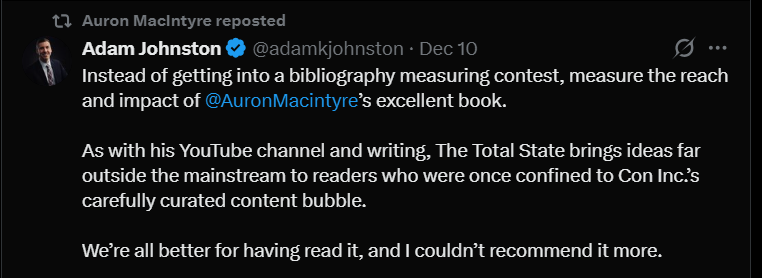
I’d add that it’s not just that research methods and capabilities have changed (and put subscription-based databases out of business). More than that, the basis of authority is changing to the (net) benefit of all of us but the detriment of current occupants of academe. This complaint about Auron McIntyre’s book captures what I mean.

Leaning on the “credibility” of the self-serving customs of the credentialed class is becoming a losing strategy and will keep losing. Now, Auron’s book is a popular level book, obviously. And it’s not long. You can, and should, read it in one sitting. I don’t recall seeing a non-academic book being criticized for a scant bibliography. It’s just because this one is right wing and, therefore, unserious. Simple as that.

Moreover, and again, this just isn’t going to work anymore. Not only is the right wing—the people shoved out of respectable, mainstream institutions—the only place that anything intellectually interesting happens. So, yeah, they’re going to cite YouTube videos and Substack articles. That’s where the interesting ideas and interesting people are producing right now.
Why do you need citations anyway in this case? Unless you’re employing someone else’s ideas, it’s okay to just make observations and arguments. And that’s the thing. With the degeneration of the academy and adjacent institutions, people (especially on the right) don’t blindly trust the credentials and the titles and the bibliographies. Heather Cox Richardson has a lengthy “bibliography” in all her Substack posts, and she sounds absolutely crazy. By the way, why is she allowed to blog? The point is that the shifts we’re seeing are good (in general).
Types like Sami will go kicking a screaming, but eventually people are going to be forced to actually make and assess arguments, real ideas, rather than just relying on the appearance of rigor and credibility. Can’t happen soon enough. That’s why you should read early modern sources: it will make you better at doing this. Adam Johnson is right about new media and the new right. We’ll see who wins.
Spotlight
I want to highlight other guys doing great work in our little niche of early modern theology and history. Edwin Nunez’s YouTube channel, Scholasticism Reformed, is excellent. Get him over 1000 followers!
If you’re not already subscribed to Michael Lynch’s Substack, do so now. It’s the only place you can get the early modern Latin translations he’s been doing for a few years now.
Updates
My article on Pierre de la Place’s political thought is now up at Christ Over All. Politics is the art of ordering all vocations, all arts together. La Place was saying this kind of thing a bit before Althusius. Check it out.
New from me this month at American Reformer is a piece that got a lot of attention, “The Trouble with Unemployed Scholars,” and a book review of On the Duty of Merchants by Daniel Souterius.
Please Do the Reading
Book: I talked some about Erastianism in my most recent essay on Samuel Pufendorf. This week’s assignment, then, is to go read Thomas Erastus (1524-1583), A treatise of excommunication.
Sermon: This sermon by John Owen, preached in the Commons the day after the execution of Charles I, came up in a conversation the other day. You can listen to it here. What’s controversial about it is that Owen never actually mentions the event directly.
Article: As you know from prior posts, I’m interested in the way early modern Protestants thought about and used Machiavelli. I came across this text, The Machavilian Cromwellist (1648), by William Prynne. It’s shockingly short for Prynne (only 11 pages!), so we’ll count it as an article.
Bonus
I’m working on a review of Hunter Powell’s The crisis of British Protestantism: Church power in the Puritan Revolution, 1638-44. (Manchester Press has put out some great stuff, like Collinson’s This England.) I highly recommend it. Powell is a good writer and (though I didn’t realize this when I picked it up), it’s probably the best detailed study of the Dissenting Brethren (Congregationalists). I’m also reviewing Blazing World: A New History of Revolutionary England, 1603-1689 (2033), by Jonathan Healey. I don’t love it so far. You’re better off just reading Christopher Hill.
Jack Waters recommended Wycliff: Political Ideas and Practice by Michael Wilks. Just starting so can’t recommend yet, but it looks great. It’s hard to find good secondary literature on Wyclif’s political thought. John Wyclif as Legal Reformer by William Farr is the best I’ve come across so far.